Saturday, 5 April 2014

Imran Farhat

Imran Farhat Biogiraphy

A gifted young left-handed opener who threatened at one stage to solve Pakistan's perennial opening conundrum, Imran Farhat had a brief spell in the Pakistan side after success with the national under-19 and A sides. Farhat also evokes Saeed Anwar but only fleetingly; he bludgeons rather than times his runs. He was rather too cavalier in his early appearances in the Test arena, and was promptly discarded after the tour to New Zealand in 2000-01. However, he tightened his game and achieved much more success in the 2003-04 season. Tempering his impressive array of shots with better defensive technique, Farhat scored a deluge of runs in the home series against South Africa and New Zealand, being involved in a record four successive hundred partnerships with Yasir Hameed in the one-day internationals against New Zealand. He also notched up his first century in both Tests and ODIs during this season, and then went on to score a vital 101 in Pakistan's victory against India in the Lahore Test. But since the India series, he has fallen away. A mediocre series at home to Sri Lanka and away to Australia saw him falter, especially with the emergence of the other left-handed opener, Salman Butt. When Pakistan included only one specialist opener in the squad for the series against England in 2005 - Butt - seemingly it confirmed that Farhat, temporarily, was out of national reckoning. But as an opener in Pakistan, you are never out of national reckoning and sure enough Farhat was back for the final Test against India, where he scored a fifty. That performance saw him on the plane to Sri Lanka and an average series. But with openers becoming as rare as dinosuars in Pakistan, he was retained for the summer tour to England, where he again produced some mixed results. Despite failures in the first two Tests, a broken finger and a spate of dropped catches, he came back to score a cavalier 91 in the final, fateful Oval Test. Runs against West Indies at home were followed by a barren patch in South Africa. A first away hundred followed by a patient half-century in the Napier Test of 2009 has set him up for a long sojourn in the Test side. His ODI career has however hit roadblocks since he was dropped after an indifferent run of scores in 2006.

Imran Farhat


Imran Farhat


Imran Farhat


Imran Farhat


Imran Farhat


Imran Farhat


Imran Farhat


Imran Farhat


Imran Farhat


Imran Farhat


Imran Farhat


Waqar Wounus

Waqar Wounus Biogiraphy

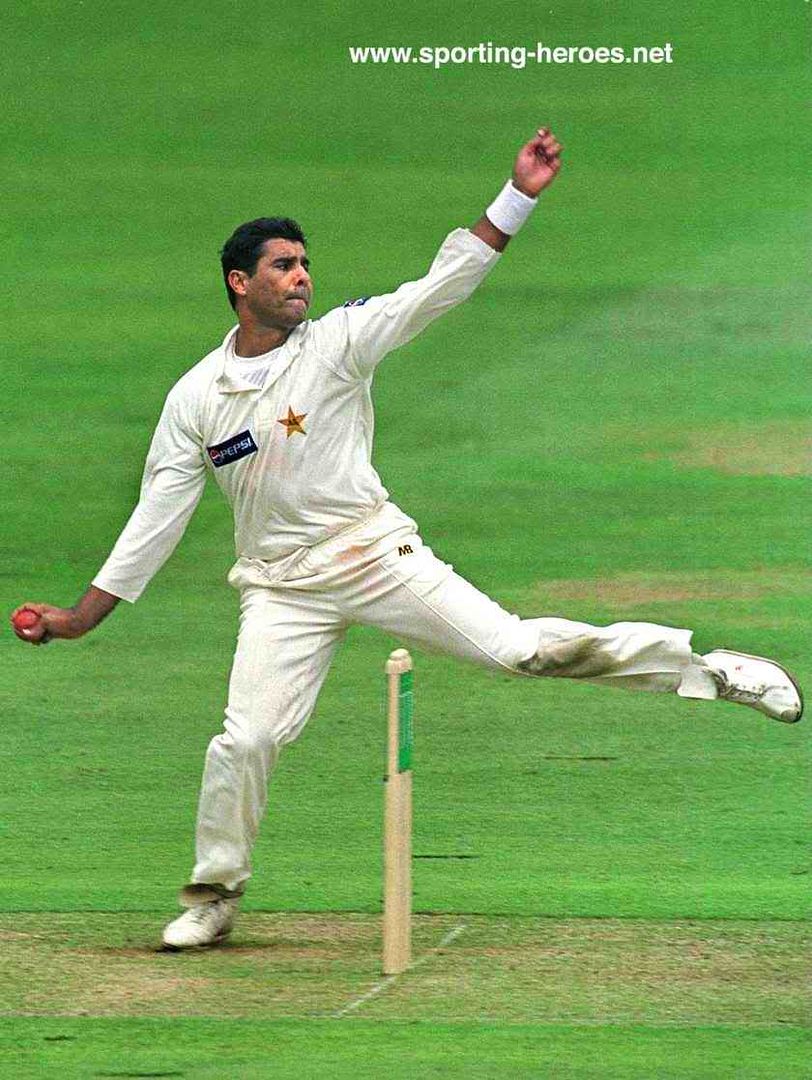
Waqar Younis Maitla is a former Pakistani right arm fast bowler in cricket and widely regarded as one of the best fast bowlers of all time.

He was best known in cricket for his ability to reverse swing a cricket ball at high speed when bowling at the cricket pitch. He took 373 Test wickets and 416 One Day International wickets during his career. He is considered to be the best exponent of the swing bowling delivery. Younis has the best strike rate for any bowler with over 200 Test wickets. He worked as a bowling coach with the national side from 2006 to 2007.

Younis was appointed as the coach of the Pakistan cricket team on 3 March 2010. His managerial contract with the Pakistan Cricket Board will take part in all forms of cricket, right up to December 2011, which will include all professional competitions, such as the 2011 Cricket World Cup.

Early and personal life
Younis was born in Vehari, Punjab in Pakistan in a Jatt family. He was educated in Sadiq Public School in Bahawalpur in Pakistan, the Pakistani College (Pakistan Islamia Higher Secondary School) in Sharjah and the Government College University in Vehari. He was raised in Sharjah in the United Arab Emirates, where his father was a contract worker. He returned to Pakistan during his adolescent years and there, he started playing cricket.

He is married to Dr. Faryal Waqar Younis with a son Azaan Waqar and a daughter Maira Waqar and now lives in Castle Hill in Australia. Younis has also worked as a television sports commentator for the Nine Network in Australia and for Ten Sports in the United Arab Emirates.

Cricket and coaching career
Younis began his cricket career in Pakistan, playing for several First-class cricket clubs. However he suffered an injury when he had cut and removed his little finger on his left hand, after he had jumped into a canal. He recovered from this accident and went on to continue his sporting career. He was eventually discovered by former Pakistan captain, Imran Khan and was selected to be part of the national side. The turning point of his career happened in England, during the late 1980s and early 1990s, when he played for Surrey County Cricket Club. There he displayed excellent cricketing performances and attracted attention from the sporting public.

He made his International cricket debut for Pakistan against India on 15 November 1989, in the same match that Indian batsman Sachin Tendulkar also made his debut. Younis took 4 wickets in the drawn match including the wickets of Tendulkar and Kapil Dev. He made an immediate impression with his speed and became known in the cricket media as "Wiki" or the "Burewala Express". Younis along with Wasim Akram opened the bowling attack regularly for Pakistan, becoming a feared and potent attack. His most recognized delivery was an inswinging yorker. At his peak, he developed into a very quick fast bowler and also became famous for achieving a hat-trick in a One Day International match against New Zealand in 1994. He won the English County Championship with Glamorgan in 1997. During the early periods of 2000, he stayed out of the Pakistan team for a brief period allegedly due to suspension and conflicts with bowling partner and captain Wasim Akram. His return to cricket came with him being appointed the captain of Pakistan, a position he held until his team failed to make an impact in the 2003 Cricket World Cup. He retired from cricket in 2003 after the Pakistan Cricket Board persistently ignored him for national selection.

In March 2006, he was appointed as the bowling coach for Pakistan. He resigned from this position on 6 January 2007 in protest against the Pakistan Cricket Board decision to retain him only for the Test series against South Africa and not for the subsequent series of five One Day International matches. He was re-appointed as Pakistan's bowling and fielding coach for their tour of Australia in December 2009. In February 2010, Younis was appointed the head coach of Pakistan after Intikhab Alam was sacked as coach, due to the low-level of performances of the national side during the tour of Australia earlier that year.

Waqar Wounus


Waqar Wounus


Waqar Wounus


Waqar Wounus


Waqar Wounus


Waqar Wounus


Waqar Wounus


Waqar Wounus


Waqar Wounus


Waqar Wounus

Waqar Wounus

Waseem Akram


Waseem Akram Biogiraphy

source linh (google.com
Full name Wasim Akram
Born June 3, 1966 Lahore, Punjab, Pakistan
Height 6 ft 2 in (1.88 m)
Role Bowler
Batting style Left-handed
Bowling style Left-arm fast
International information
Test debut (cap 102) 25 January 1985: v New Zealand
Last Test 9 January 2002: v Bangladesh
ODI debut (cap 53) 23 November 1984: v New Zealand
Last ODI 4 March 2003: v Zimbabwe
Domestic team information
Years Team
2003 Hampshire
2000/01 Lahore Blues
1992/93 – 2000/01 Pakistan International Airlines
1988 – 1998 Lancashire
1997/98 Lahore City
1985/86 Lahore City Whites
1984/85 – 1985/86 Pakistan Automobiles Corporation

Wasim Akram (Urdu: وسیم اکرم)(born June 3, 1966 in Lahore, Punjab) is a former Pakistani cricketer. He was a left-arm fast bowler and left-handed batsman, who represented the Pakistani cricket team in Tests and One-Day Internationals. He is widely regarded as one of the finest fast bowlers ever and holds world records for the most wickets taken in both ODIs (502) and List A cricket (881). Domestic career
Wasim signed for Lancashire in 1988 and went on to become one of their most successful overseas players. From 1988 to 1998, he spearheaded their attack in their NatWest Trophy, Benson & Hedges Cup and Sunday League winning sides. He was a favourite of the local fans who used to sing a song called "Wasim for England" at Lancashire's matches.

Waseem Akram


Waseem Akram

Waseem Akram


Waseem Akram

Waseem Akram

Waseem Akram


Waseem Akram

Waseem Akram

Waseem Akram

Waseem Akram

Thursday, 3 April 2014

saeed ajmal

Saeed Ajmal Biogiraphy

sorsec link (google.com)
Saeed Ajmal (Punjabi, Urdu: سعید اجمل‎; born 14 October 1977) is aPakistani cricketer. He is a right-arm off-spin bowler who bats right handed.
At domestic level in Pakistan he has represented Faisalabad, with whom he won the 2005 ABN-AMRO Twenty-20 Cup; Khan Research Laboratories; and Islamabad. Ajmal made his One Day Internationaldebut for Pakistan in July 2008 at the age of 30, and a year later played his first Test. In 2009 he was reported for having a suspect bowling action, but after being cleared he helped Pakistan win the 2009 ICC World Twenty20. Ajmal played for Worcestershire as an overseas player in English domestic cricket in 2011. Since November 2011, Ajmal has been ranked by the International Cricket Council as the number one bowler in ODIs. He is ranked at number two in ICC ranking of bowlers in T20Is, while his current ICC test bowler ranking is number 5.[1] He is one of four test bowlers that made their debut after the age of thirty to take more than 100 test wickets. The other three being Clarrie Grimmett, Dilip Doshi and Ryan Harris.[2]
On 28 January 2012, in his 20th Test, Ajmal became the quickest Pakistani to take 100 test wickets.[3] Saeed Ajmal holds the record of leading wicket taker(83) in Twenty20 International cricket.[4]
Ajmal was signed by Adelaide Strikers for the 2012 Big Bash League in Australia.[5] He has taken 400 International wickets in a span of 5 years.
Saeed Ajmal has played for Faisalabad since his debut in 1995 at the age of 18. Ajmal represented the Faisalabad Wolves in the 2005 ABN-AMRO Twenty-20 Cup, his team won the final in which he was man of the match.[6][7] When Faisalabad won the final of the ABN-AMRO Patron's Cup in March 2006 Ajmal was named the tournament's best bowler and was given a Rs 25,000 prize.[8] He has also represented Khan Research Laboratories, who were runners-up in the final of the 2008/09 Quaid-i-Azam Trophy; though his side lost the final, Ajmal took 5/105 and 2/55 and in the process passed 250 first-class wickets.[9][10] Ajmal has also played for Islamabad.

Saeed Ajmal has played for Faisalabad since his debut in 1995 at the age of 18. Ajmal represented the Faisalabad Wolves in the 2005 ABN-AMRO Twenty-20 Cup, his team won the final in which he was man of the match.[6][7] When Faisalabad won the final of the ABN-AMRO Patron's Cup in March 2006 Ajmal was named the tournament's best bowler and was given a Rs 25,000 prize.[8] He has also represented Khan Research Laboratories, who were runners-up in the final of the 2008/09 Quaid-i-Azam Trophy; though his side lost the final, Ajmal took 5/105 and 2/55 and in the process passed 250 first-class wickets.[9][10] Ajmal has also played for Islamabad.

Saeed Ajmal has played for Faisalabad since his debut in 1995 at the age of 18. Ajmal represented the Faisalabad Wolves in the 2005 ABN-AMRO Twenty-20 Cup, his team won the final in which he was man of the match.[6][7] When Faisalabad won the final of the ABN-AMRO Patron's Cup in March 2006 Ajmal was named the tournament's best bowler and was given a Rs 25,000 prize.[8] He has also represented Khan Research Laboratories, who were runners-up in the final of the 2008/09 Quaid-i-Azam Trophy; though his side lost the final, Ajmal took 5/105 and 2/55 and in the process passed 250 first-class wickets.[9][10] Ajmal has also played for Islamabad.

Saeed Ajmal
Saeed Ajmal
Saeed Ajmal
Saeed Ajmal
Saeed Ajmal
Saeed Ajmal
Saeed Ajmal
Saeed Ajmal
Saeed Ajmal
Saeed Ajmal
Saeed Ajmal

shahid afridi

shahid afridi biogiraphy
soursec link (google.com)
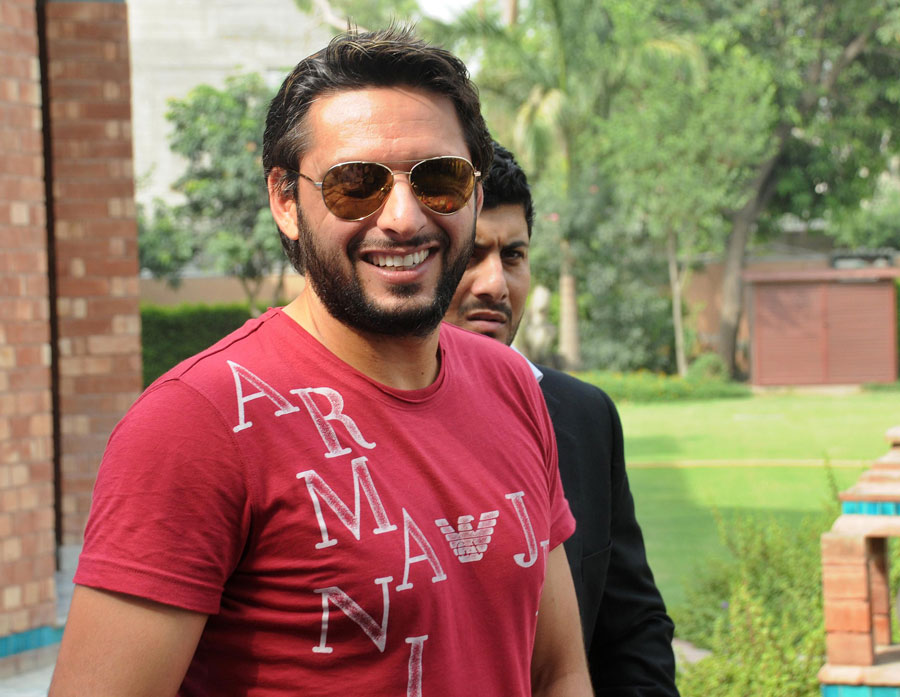
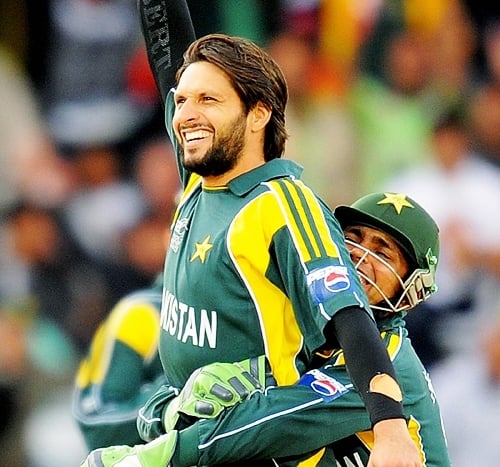
Sahibzada Mohammad Shahid Khan Afridi, popularly known as Shahid Afridi, is a Pakistani cricketer. Between 1996 and 2012, Afridi played 27 Tests, 334 One Day Internationals, and 46 Twenty20 International for the Pakistani national team.
He made his ODI debut on 2 October 1996 against Kenya and his Test debut on 22 October 1998 against Australia.
He is known for his aggressive batting style, and holds the record for the fastest ODI century which he made in his first international innings, as well as scoring 32 runs in a single over, the second highest scoring over ever in an ODI.
He also holds the distinction of having hit the most number of sixes in the history of ODI cricket.Afridi considers himself a better bowler than batsman, and has taken 48 Test wickets and over 300 in ODIs.
Currently Afridi is the leading wicket taker in the Twenty20 format taking 53 wickets from 43 matches.Shahid Afridi has signed to play for the Sydney Thunderin Australia’s Twenty20 Big Bash league.
In June 2009, Afridi took over the Twenty20 captaincy from Younus Khan, and was later appointed ODI captain for the 2010 Asia Cup. In his first match as ODI captain against Sri Lanka he scored a century however Pakistan still lost by 16 runs.
He then also took over the Test captaincy but resigned after one match in charge citing lack of form and ability to play Test cricket; at the same time he announced his retirement from Tests. He retained the captaincy in limited-overs form of the game and led the team in the 2011 World Cup. In May 2011, having led Pakistan in 34 ODIs Afridi was replaced as captain.
Later that month he announced his conditional retirement from international cricket in protest against his treatment by the Pakistan Cricket Board (PCB); in October he reversed his decision. UNICEF and Pakistani authorities have taken Shahid Afridi on board for its anti-polio campaign in the tribal belt of lawless Waziristan region.


shahid afridi


shahid afridi


shahid afridi


shahid afridi


shahid afridi


shahid afridi

shadid afridi


shahid afridi